The United States announced plans to withdraw approximately 5,000 troops from Germany over the next six to twelve months. The decision represents one of the most significant changes to the American military presence in Europe in recent years and has sparked debate among NATO allies, defence analysts, and political leaders.
Germany has long been one of the most important hubs for U.S. military operations in Europe. American bases in Germany support NATO missions, logistics, intelligence operations, training exercises, and rapid deployment capabilities. The reduction therefore carries strategic, political, and diplomatic implications for both Europe and the broader transatlantic alliance.
Approximately 35,000–36,000 U.S. troops are stationed in Germany. The U.S. military presence in Germany dates back to the end of World War II. During the Cold War, hundreds of thousands of American troops were stationed there to deter the Soviet Union and defend Western Europe. Although troop numbers declined significantly after the Cold War, Germany remained a central location for U.S. operations because of its strategic geographic position in Europe, advanced military infrastructure, strong NATO partnerships, and major bases such as Ramstein Air Base and Stuttgart headquarters.
According to Pentagon statements and media reports released on May 1–2, 2026, the United States plans to remove around 5,000 personnel from Germany. The withdrawal reportedly includes an Army brigade combat team, Support and logistics personnel, and Cancellation of a planned long-range fires battalion deployment.
The Pentagon explained that the move is part of a broader review of American force posture and global strategic priorities. U.S. officials emphasized that America remains committed to NATO despite the troop reduction and the reduction would occur gradually over six to twelve months.
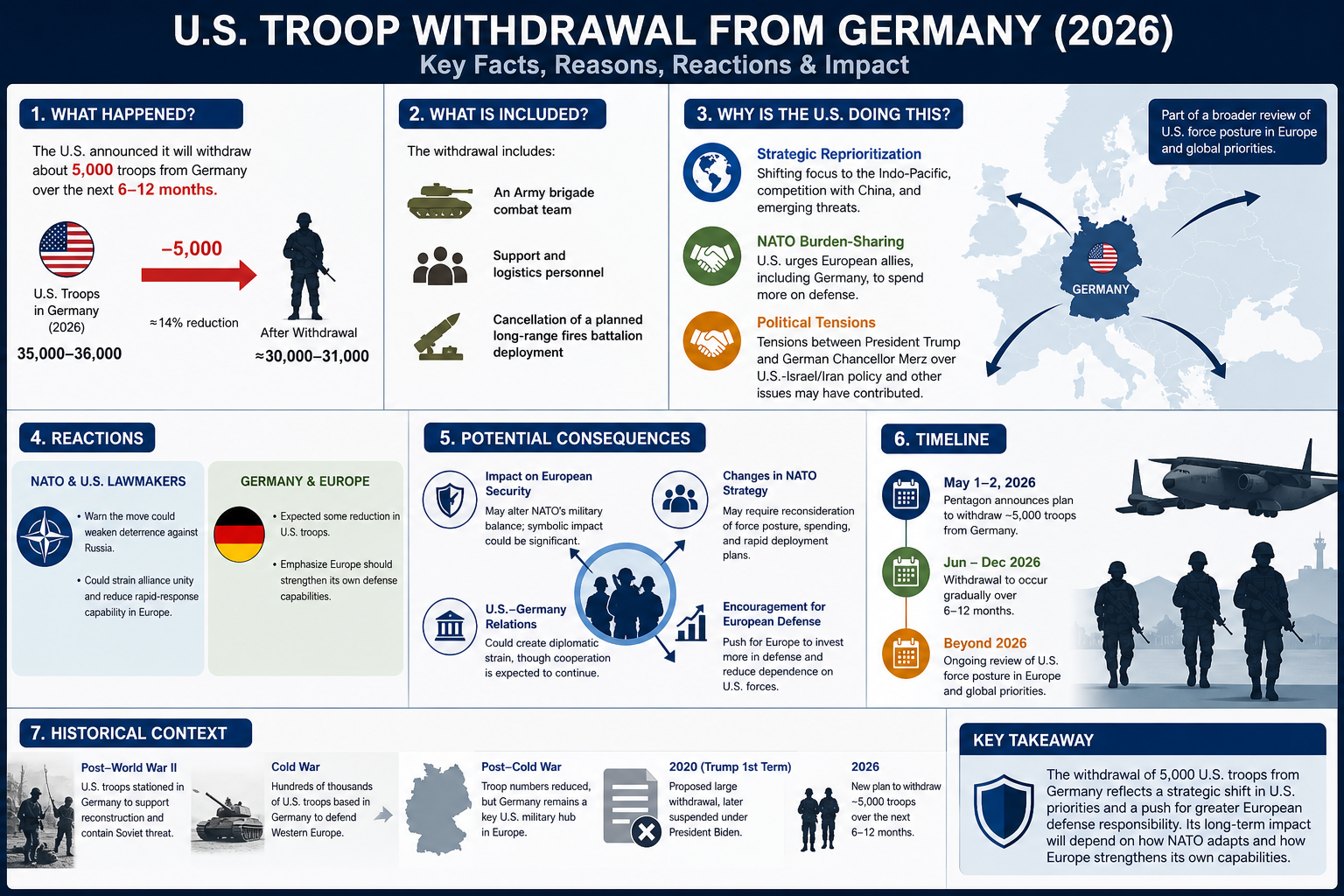
Factors influencing the decision:
The United States has increasingly shifted military attention toward:
The Indo-Pacific region
Competition with China
Emerging technological warfareCyber and missile defence systems
Reducing troop numbers in Europe may allow resources to be redirected elsewhere.
Burden-Sharing Within NATO
American leaders have repeatedly argued that European allies should contribute more to their own defence spending and military readiness. President Donald Trump has long criticized NATO members, including Germany, for not spending enough on defence relative to GDP. Reports indicate that political disagreements between Washington and Berlin may also have played a role. Differences reportedly emerged regarding Middle East policy and broader security issues. Although neither government officially described the move as punitive, analysts believe diplomatic tensions contributed to the decision. Several NATO officials and defence experts warned that the withdrawal could weaken deterrence against Russia and reduce alliance cohesion. Concerns include reduced rapid-response capability in Europe, increased uncertainty among Eastern European allies, and possible encouragement of Russian military assertiveness. German officials responded cautiously. While expressing concern over alliance unity, they also emphasized the importance of Europe strengthening its own defence capabilities. German policymakers argued that Europe should become less dependent on U.S. military support over time.
Impact on European Security
The reduction may alter NATO’s military balance in Europe, particularly if tensions with Russia continue. Although 5,000 troops represent only a portion of the total U.S. force in Europe, symbolic effects may be significant. NATO may need to reconsider force deployment structures, European defence spending, joint military planning, and rapid mobilization capabilities. The withdrawal could place additional strain on diplomatic relations between the two countries. However, both governments have stated that long-term cooperation will continue. This is not the first-time troop reductions in Germany have been proposed.
During President Trump’s first administration, a larger withdrawal plan was announced in 2020 but later suspended under President Joe Biden. The 2026 decision therefore reflects continuing debate within U.S. foreign policy regarding America’s role in Europe, NATO burden-sharing, and Global military priorities.
Conclusion
The planned withdrawal of 5,000 U.S. troops from Germany marks an important development in transatlantic security policy. While American officials describe the move as a strategic adjustment, critics warn it could weaken NATO deterrence and create uncertainty in Europe. The decision highlights broader global shifts in U.S. defence strategy, including increased focus on Asia and demands for greater European military responsibility. Its long-term impact will depend on how NATO adapts and whether European allies increase their defence capabilities in response.
Overall, the withdrawal represents not only a military change but also a significant political signal regarding the future direction of U.S.–European relations and international security cooperation.