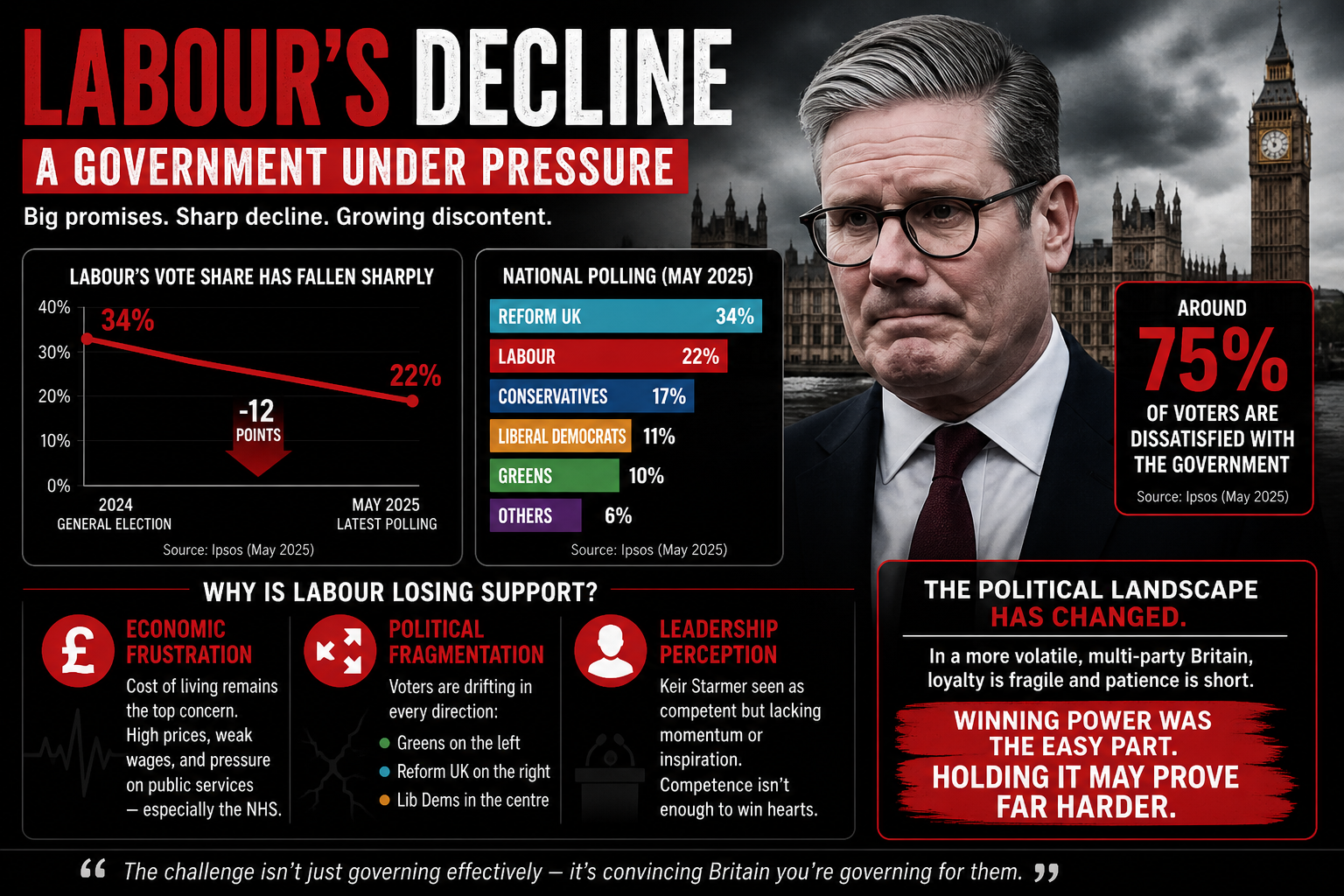
The Labour Party entered government on a promise of competence, renewal, and economic stability after years of political turbulence. Yet, not long into office, it finds itself grappling with a familiar affliction of British politics: a sharp and growing decline in public confidence. What was meant to be a period of consolidation has instead become one of mounting dissatisfaction. Polling fluctuations, restless voters, and increasingly fractured electoral loyalties suggest a government struggling to define its political identity in office, just as much as it did in opposition.
Economic Reality Meets Political Expectation
At the heart of Labour’s difficulties lies the enduring weight of economic stagnation. The cost-of-living crisis continues to dominate public sentiment, shaping perceptions more powerfully than any manifesto commitment or policy announcement. Households remain squeezed by persistent inflationary pressures, high housing costs, and stagnant wage growth. Public services, meanwhile, continue to strain under demand. The National Health Service remains a particular source of frustration, with waiting times and staffing shortages symbolising a wider sense of institutional fatigue. Governments are rarely judged on inherited circumstances; they are judged on outcomes. In that respect, Labour’s early tenure has been marked less by transformation than by the stubborn persistence of familiar problems.
Leadership Without Momentum
Prime Minister Keir Starmer has projected an image of discipline and managerial seriousness. Yet politics in Britain is not governed by administration alone. It requires momentum, narrative, and a sense of direction. Qualities that Labour has struggled to project with consistency. Where earlier Labour leaders such as Tony Blair commanded a strong electoral rhythm, and Jeremy Corbyn mobilised ideological fervour within sections of the electorate, Starmer’s leadership has been defined more by caution than conviction in the public imagination. To supporters, this caution is a virtue, evidence of a party determined to avoid instability. To critics, it reads as hesitation at a moment when decisive political identity is required. Labour’s broader difficulty lies in its increasingly unstable electoral coalition.
The party is being squeezed from both left and right in ways that would have been far less pronounced in earlier political eras.
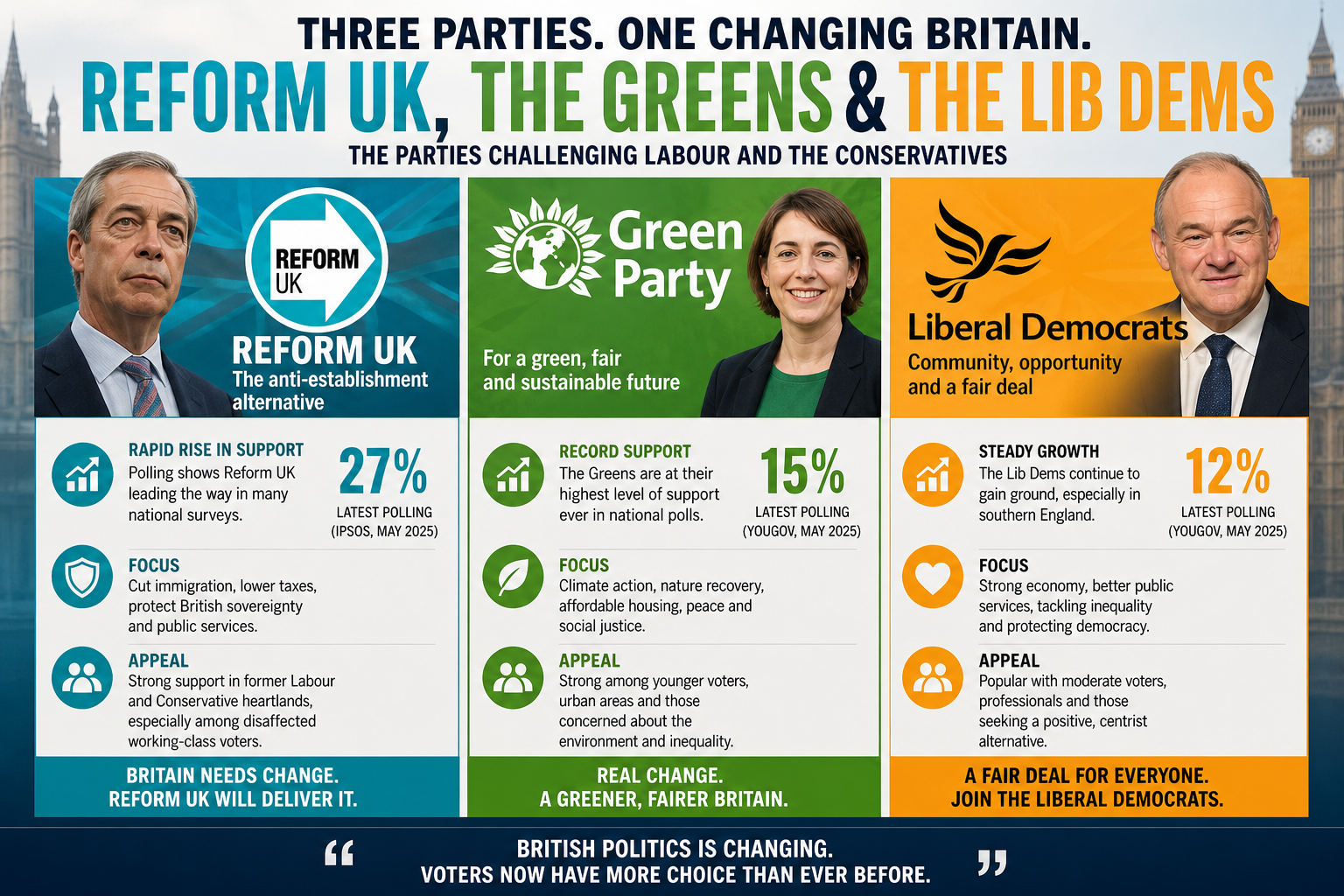
On the left, disaffected progressives argue that Labour has diluted its traditional commitments to redistribution, public ownership, and welfare expansion. Some of this electorate is drifting towards the Green Party of England and Wales or independent candidates who present a clearer ideological alternative.
On the right, particularly in post-industrial and coastal constituencies, concerns over immigration, national identity, and perceived neglect have created openings for the Reform UK and other insurgent forces. These voters are often less interested in ideological purity than in a sense of control, order, and responsiveness from government.
The result is a party attempting to hold together constituencies with increasingly divergent expectations, a political balancing act that grows more precarious with each electoral cycle
Foreign Policy Domestic Fallout, and Fragmentation of the British Political Order
Foreign affairs have added an additional layer of domestic difficulty. Labour’s position on the Israel–Gaza conflict has proven politically sensitive, particularly in urban constituencies with significant Muslim populations and among younger progressive voters. While foreign policy is rarely decisive on its own in British elections, it can act as a catalyst for disengagement, protest voting, or abstention, all of which carry significant consequences in tightly contested urban seats. Perhaps the most profound challenge facing Labour, however, is structural rather than cyclical. The era of predictable two-party dominance between Labour and the Conservative Party is increasingly fractured. British politics is now defined by volatility and fragmentation. Voters are more willing than ever to shift allegiance between parties, or to support smaller movements entirely.
The rise of Reform UK, the Greens, the Liberal Democrats, and a range of independents has complicated the traditional electoral map beyond recognition. This fragmentation makes governing harder, opposition more fluid, and political identity more contested. It also ensures that declines in support can be sharper and more sudden than in previous political eras.
Conclusion: A Government Still Searching for Definition
Labour’s current predicament is not simply one of declining popularity, but of contested purpose. It governs at a moment when economic pressures are stubborn, political loyalties are fluid, and voter expectations are both immediate and unforgiving. Whether this represents a temporary dip in public approval or the beginning of a deeper structural realignment in British politics remains uncertain. What is clear, however, is that the government’s greatest challenge is no longer simply to deliver policy, but to convince the electorate that it has a coherent vision of what it is governing for.
Labour’s problem is not just declining popularity, it is governing in an era where loyalty is fragile, opposition is fragmented, and patience is in short supply. Winning power was the easy part, holding it may prove far harder.